Movement Is the Tell: Why Stillness Beats Perfect Camouflage
If there’s one truth that keeps resurfacing after years in the field, it’s this:
Camouflage doesn’t usually get you busted.
Movement does.
Most hunters spend an enormous amount of time debating patterns, colors, and brands. And while camouflage can matter in specific moments, deer rarely pick you out because your camo “failed.” They pick you out because something moved where nothing should have.
Understanding that distinction changes how you hunt.
Why Deer Notice Movement Before Anything Else
Deer don’t see the world the way we do. Their visual acuity is lower, fine detail is muted, and colors compress into simpler tones. What they do see extremely well is motion—especially lateral movement.
Their eyes are built to scan wide areas for change. Anything that shifts unexpectedly in a static environment triggers attention. This is why a hunter wearing average camo who remains still often goes unnoticed, while a hunter wearing “perfect” camo gets busted the moment they move.
Movement breaks the illusion faster than color ever will.
Peripheral Vision and the Problem of “Almost Still”
Deer rely heavily on peripheral vision. Even subtle motion—raising a bow too quickly, turning a head at the wrong time, adjusting a foot on a stand—can register instantly if it happens in open view.
What makes this especially tricky is that these movements often feel insignificant to us. We aren’t standing up. We aren’t waving our arms. We’re just making a small adjustment.
To a deer, that adjustment is the only thing that changed in the entire landscape.
This is why hunters often say, “I don’t know how it saw me.” Nothing changed—except you.
Why Camouflage Still Matters (But Not How Most People Think)
Camouflage doesn’t stop movement from being seen. What it can do is soften the visual impact of movement.
When your pattern breaks up your outline and blends with surrounding tones, small movements are less likely to register as a defined human shape. That gives you margin—sometimes just enough margin to finish a draw or settle before the deer fully processes what it saw.
Camo doesn’t make movement invisible. It makes movement harder to interpret.
Tree Stands vs Ground Hunting: Different Movement Rules
Movement matters everywhere, but how it betrays you differs by setup.
In tree stands:
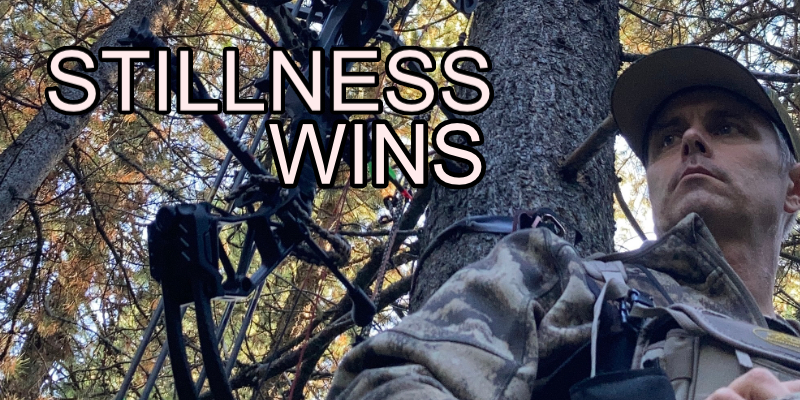
- Movement is often silhouetted against sky or open timber
- Vertical motion (standing, leaning, drawing) is highly visible
- Stillness before movement matters more than speed
On the ground:
- Horizontal movement is more dangerous
- Depth perception plays a larger role
- Using cover to mask motion becomes essential
In both cases, the rule is the same: move only when the deer’s attention is elsewhere.
Confidence Reduces Movement
There’s a psychological layer to all of this that doesn’t get enough attention.
Hunters who feel exposed tend to fidget.
Hunters who feel hidden tend to stay still.
This is one of the underrated benefits of wearing camo you trust. Even if it isn’t perfect, confidence reduces unnecessary movement—fewer adjustments, less shifting, more patience.
Confidence doesn’t come from believing camo makes you invisible. It comes from knowing you’re doing enough to stay disciplined.
The Stillness Threshold
Every successful hunt eventually reaches a moment where movement must happen. You can’t stay frozen forever. The key is understanding when that moment is least costly.
Good hunters don’t avoid movement. They delay it.
They wait until:
- The deer’s head is turned
- Its vision is obstructed
- It’s committed to a travel line
- It’s distracted by something else
That patience often matters more than any pattern choice.
Why Hunters Misdiagnose What Went Wrong
When a deer busts a hunter, the first instinct is to blame camo, scent, or luck. Movement is rarely blamed because it often feels unavoidable or invisible in hindsight.
But if you replay most encounters honestly, there’s usually a moment—small and forgettable—where movement broke the spell.
Recognizing that pattern is how hunters get better.
The Real Hierarchy of Concealment
If you had to rank what actually keeps you hidden, it would look something like this:
- Stillness
- Positioning
- Wind discipline
- Use of shadow and cover
- Camouflage
Camo supports the system—but it doesn’t lead it.
Final Thought
Camouflage can help you when everything else is right. It cannot save you when movement is wrong.
The hunters who consistently succeed aren’t the ones chasing perfect patterns. They’re the ones who understand when to move, when not to move, and how to disappear by doing nothing at all.
Stillness is not passive. It’s a skill.