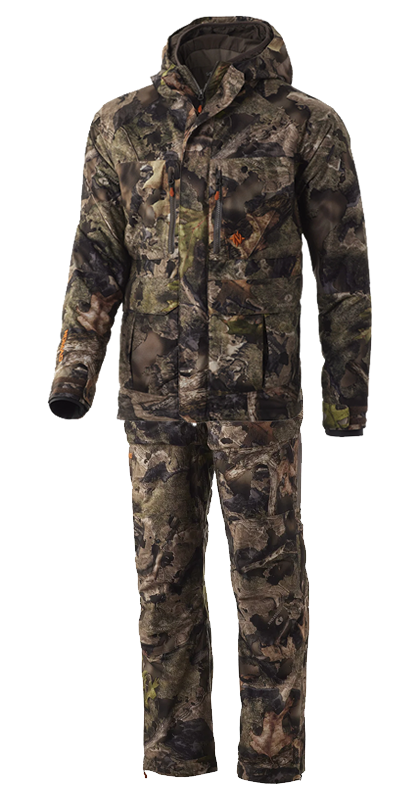
Vertek
Mossy Oak Droptine

AI Environment Insight

Against Late Fall Hardwoods, Vertek scores 64/100 (), while Mossy Oak Droptine scores 56/100 ().

Based on color alignment, breakup scale, and texture density, the AI sees an approximate 8-point lean toward Vertek in this particular environment.

CamoMatrix AI Comparison

Huntworth Gear Vertek and Nomad Outdoor Mossy Oak Droptine are both mixed-scale patterns, so they behave similarly from a scale point of view. Both patterns balances micro and macro elements, keeping them fairly steady across different shot distances. They are also similar in overall density, so neither one is dramatically busier or more open.

Huntworth Gear Vertek
Nomad Outdoor Mossy Oak Droptine
Scale Type
mixed
mixed
Scale Bias
balanced
balanced
Density
dense
dense
Edge Style
soft
soft
Scale Index
0.700
0.650
Density Index
0.600
0.700
Scale Spread
0.500
0.500
×

AI Breakdown — Side-By-Side Analysis

Huntworth Gear Vertek vs Nomad Outdoor Mossy Oak Droptine

Huntworth Gear Vertek and Nomad Outdoor Mossy Oak Droptine have been analyzed using our CamoMatrix AI engine, which measures scale, density, and edge behavior directly from the flat pattern artwork. Both land in the mixed-scale category, meaning they balance fine texture with larger breakup blocks instead of living at one extreme. Density is similar, so neither pattern overwhelms the eye or leaves too much empty space. Edge work is alike as well — both leans into smoother, blended transitions, which affects how smoothly (or abruptly) each pattern merges with real brush, trunks, and rocks. Huntworth Gear Vertek's scale index trends a touch higher, making its breakup blocks slightly larger than those in Nomad Outdoor Mossy Oak Droptine. Nomad Outdoor Mossy Oak Droptine lands slightly higher on the density index, adding a bit more visual texture. That can help in chaotic or brushy terrain where extra breakup is useful. As always, these results come from flat pattern imagery. Real-world performance depends heavily on terrain, season, and how the garments fit and move.

This is a pattern-only comparison from flat artwork. Terrain, season, and real backgrounds will still push one or the other ahead in specific setups.

Ad Banner
×

CamoMatrix AI Classification Guide

Learn how the CamoMatrix AI evaluates camouflage patterns

Scale Type

Defines the dominant size of shapes in the pattern.

  • Micro — fine details for close-range concealment
  • Mixed — blend of micro + macro elements (versatile)
  • Macro — large, bold shapes built for distance

Scale Bias

Indicates which scale range the pattern leans toward overall.

  • Leans Micro — better in brush, timber, inside 40–60 yards
  • Balanced — performs similarly near and far
  • Leans Macro — stronger breakup in open terrain or longer shots

Density

How busy the pattern is with shapes and noise.

  • Sparse — more background shows through
  • Moderate — balanced texture
  • Dense — lots of detail packed tightly together

Edge Style

How hard or soft shape boundaries are.

  • Hard Edges — sharp multipoint outlines
  • Soft / Blended — smooth transitions (like spray or blur)
  • Mixed — both present

Numeric Metrics

  • Scale Index — 0.0 (micro) → 1.0 (macro)
  • Density Index — 0.0 (sparse) → 1.0 (dense)
  • Scale Spread — how widely the pattern spans micro → macro