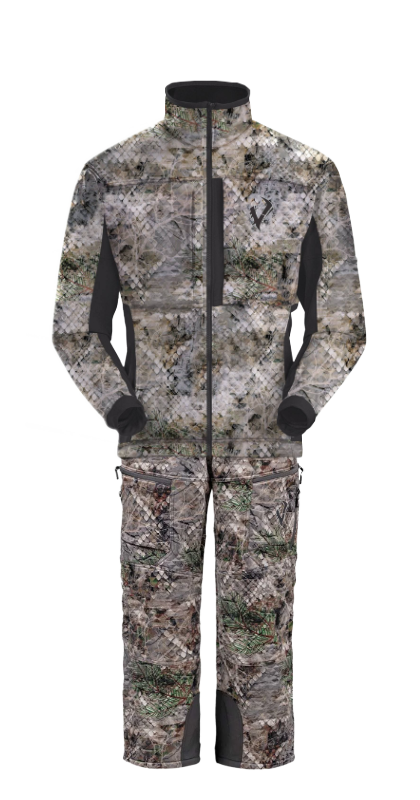
CamoMatrix Pattern DNA
Forloh
Exposed
This pattern stands out most for gray / Olive, subdued saturation; brighter than most patterns, typical tonal separation; and softer, weaker edge structure.
The dominant detected color families are Gray / Olive. Its average color saturation is low compared with the 247-pattern reference set.
What you may notice:
The pattern tends to read as muted or low-color rather than strongly colorful.
22.4% of the sampled pattern falls in the governed dark tonal range. Its tonal-group separation is within the broad middle of the reference set.
What you may notice:
The pattern reads bright at a glance.
Edge density is typical, average detected edge strength is low, and the share of qualifying edges classified as hard is low relative to the reference set.
What you may notice:
Detected boundaries tend to transition more gently than in many reference patterns.
Fine texture density is low, roughness is low, and texture uniformity is high compared with the reference set.
What you may notice:
Texture activity is distributed more consistently across the pattern.
Effective retained-region fragmentation is typical, while average retained-region elongation is low relative to the reference set.
What you may notice:
The effective division of visible regions is broadly typical.
The analyzer classifies dominant scale as macro. Fine-scale energy is low, mid-scale energy is typical, and large-scale energy is high relative to the reference set.
What you may notice:
Large visual structure makes the strongest contribution to the pattern.
Spatial information balance is high, while left-right, top-bottom, and rotational asymmetry are typical, low, and low relative to the reference set.
What you may notice:
Visual activity is spread relatively evenly across the sampled pattern.
This pattern appears best aligned with brighter or paler overall backgrounds. Its detected color families align with backgrounds containing gray rock, bark, dead wood, or neutral material and subdued olive vegetation. Its large-scale structure favors backgrounds containing broader visual masses and structural features. Its smoother, more uniform texture aligns with backgrounds whose surface detail remains relatively consistent.
Its measured characteristics may make it less naturally matched to very dark backgrounds and backgrounds dominated only by tiny repetitive detail.
Detected boundaries tend to transition more softly. Visual activity is distributed fairly evenly across the pattern.
How to read this:
These observations are derived from Pattern DNA measurements and comparisons with the frozen 247-pattern reference collection. They describe the kinds of visual backgrounds the pattern most closely aligns with; they are not a claim of field-tested performance in a specific location.
These are the closest measured matches based on Pattern DNA color, tone, texture, shape, scale and layout.
See other camouflage patterns that share measured visual characteristics with this pattern.