Best Hunting Rangefinders for 2026: Choosing the Right Rangefinder for Your Hunting Style
A hunting rangefinder removes one of the most unreliable parts of making a shot: estimating distance under pressure.
Terrain can make an animal appear closer or farther than it really is. Steep angles, open country, thick timber, fading light, and adrenaline can all distort judgment. A rangefinder gives the hunter an objective measurement before the shot and can help prevent poor holds, misplaced arrows, and unnecessary misses.
The best rangefinder is not necessarily the model with the longest advertised range or the most advanced ballistic software. A bowhunter sitting 18 feet above a hardwood ridge needs something different from a rifle hunter ranging across a western canyon.
This guide explains how angle compensation, target range, optics, scan modes, and ballistic features affect real hunting situations before recommending several of our favorite hunting rangefinders for 2026.
Why Guessing Distance Can Cost You an Opportunity
Humans are not particularly good at estimating distance, especially when terrain lacks familiar reference points.
A deer standing across a flat agricultural field may be fairly easy to judge. The same deer standing across a ravine, on a steep slope, or against a featureless western hillside can be much harder to evaluate accurately.
Even a small error matters in archery. Misjudging a deer at 35 yards as 30 yards can change the point of impact enough to produce a poor hit. Rifle trajectories are more forgiving at shorter ranges, but distance errors become increasingly important as shots extend beyond a few hundred yards.
A rangefinder does not make the shot for you. It does, however, replace a guess with information that can be used to make a better decision.
Line-of-Sight Distance Versus Angle-Compensated Distance
One of the most important rangefinder features is angle compensation.
A basic rangefinder may show the straight-line distance between the hunter and the target. This is known as the line-of-sight distance. When the hunter and target are at noticeably different elevations, that number may not represent the distance that should be used for the shot.
Gravity primarily acts over the horizontal component of the distance. A deer may be 40 yards away along the direct line from a tree stand, while the angle-compensated shooting distance is several yards shorter.
Modern hunting rangefinders often calculate this automatically and display an adjusted distance. Manufacturers use different names for the feature, but the basic purpose is the same: help the hunter account for uphill or downhill shooting angles.
Why Angle Compensation Matters for Bowhunters
Angle compensation is especially important for bowhunters because arrows have a much more pronounced trajectory than rifle bullets.
Tree stands create a downward angle, and mountain hunting can create steep uphill or downhill opportunities. Using only the line-of-sight distance can cause the hunter to hold for more distance than the arrow actually needs to travel horizontally.
A useful bowhunting rangefinder should provide fast readings at short distances, calculate angles reliably, display the result clearly, and be easy to operate with one hand.
Extreme ranging distance is usually not important for a bowhunter. A dependable reading between roughly 10 and 100 yards is far more valuable than a maximum specification measured in thousands of yards.
Best Budget Rangefinder for Bowhunting and Short-Range Hunting
Hunters working from tree stands, ground blinds, and wooded eastern terrain do not always need a premium long-range model. They need a unit that is quick, compact, easy to carry, and capable of providing an angle-adjusted reading within normal hunting distances.

Camo Deer Hunting Rangefinder 700/1000Y Laser Range Finder
The TideWe 700/1000Y rangefinder is the budget choice in this guide. Its listed range is more than adequate for bowhunting, whitetail hunting, and most eastern rifle situations.
This type of rangefinder makes sense for a hunter who normally shoots well inside 200 yards and primarily wants to eliminate guesswork. It is also an approachable first rangefinder for someone who does not yet know whether advanced ballistic functions will provide any practical value.
A budget model may not match premium units in optical clarity, display quality, ranging speed, or performance on distant nonreflective targets. For close and moderate hunting distances, however, those limitations may not materially affect the hunt.
Eastern Hunting and Western Hunting Create Different Demands
Rangefinder needs change dramatically with terrain.
Eastern Whitetail and Timber Hunting
Many eastern hunters operate in hardwoods, agricultural fields, clear-cuts, powerline rights-of-way, and relatively enclosed terrain.
Bow shots may occur between 15 and 40 yards. Rifle shots are frequently inside 200 yards, though longer opportunities can occur across fields and cutovers.
In these conditions, the most useful features are often:
- Fast readings at short and moderate distances
- Reliable angle compensation
- A display that is visible against dark timber
- Simple one-handed controls
- Compact size and low weight
A 700- or 1,000-yard model is normally more than sufficient for this style of hunting.
Western and Open-Country Hunting
Western hunting can involve large basins, open sage flats, canyons, alpine slopes, and long distances between the hunter and the target.
A hunter may use the rangefinder to measure distant trees, rock formations, ridgelines, and animals while planning a stalk. The rangefinder is therefore valuable long before a shot opportunity develops.
Hunters who are trained, properly equipped, and comfortable making ethical shots at 400 to 500 yards need more than a close-range reading. They need a unit that can range nonreflective targets reliably, account for steep angles, provide a visible display in changing light, and ideally integrate useful ballistic information.
A long advertised range can be beneficial in this environment, but only when the rangefinder can consistently produce readings on the kinds of targets hunters actually encounter.
Advertised Range Versus Real Hunting Range
A rangefinder labeled for 2,000, 4,000, or 5,000 yards may not range a deer at anything close to that distance.
Maximum-range claims are often based on large reflective targets under favorable conditions. A light-colored building, road sign, or reflective panel returns a laser signal more easily than the hide of an elk or deer.
Real-world performance can be affected by:
- Target size
- Target color and reflectivity
- Rain, snow, dust, fog, or heat shimmer
- Brush and grass between the hunter and target
- Hand movement
- The angle of the target
- The quality of the laser and sensor
This is why hunters should pay attention to advertised deer range, tree range, or nonreflective target range when those figures are available, rather than looking only at the largest number printed on the box.
What Features Actually Matter in a Hunting Rangefinder?
Angle Compensation
This is one of the most useful features for both bowhunters and rifle hunters. It helps account for steep uphill and downhill shots and is far more important than extreme range for many hunters.
Fast Target Acquisition
Animals do not always remain still. A useful rangefinder should return a reading quickly and without requiring repeated attempts.
Scan Mode
Scan mode continuously updates distance as the hunter moves the reticle across terrain or follows a moving animal. It is helpful for measuring several landmarks, tracking an animal, or understanding how distance changes across a slope.
Display Visibility
A black display can disappear against dark timber, while an overly bright display can be distracting near dawn and dusk. Adjustable illuminated displays are easier to use across changing conditions.
Optical Quality
A rangefinder is also a small monocular. Better glass makes it easier to identify the intended target, place the reticle precisely, and use the unit in low light.
One-Handed Operation
Hunters may be holding a bow, rifle, trekking pole, or pack strap with the other hand. Simple controls and a body that fits securely in one hand matter more in the field than they may appear to matter in a store.
Weather Resistance
A hunting rangefinder should tolerate rain, snow, dust, and rapid temperature changes. Waterproof or water-resistant construction should be treated as a basic requirement.
Battery Life
Rangefinders typically use compact batteries that can last a long time, but cold weather and heavy use can shorten battery life. Carrying a spare battery in the pack is inexpensive insurance.
Do You Need a Ballistic Rangefinder?
A ballistic rangefinder combines measured distance with information used to predict bullet drop or shooting correction.
Depending on the model, it may account for:
- Shooting angle
- Bullet trajectory
- Muzzle velocity
- Ballistic coefficient
- Environmental conditions
- Wind or holdover data
That does not mean every hunter needs one.
Bowhunters
Most bowhunters need accurate angle-compensated distance, not a complex rifle ballistic solver.
Typical Eastern Rifle Hunters
A hunter whose shots remain inside roughly 200 yards may gain little from advanced ballistic integration. A reliable reading and basic angle compensation may provide everything needed.
Long-Range Rifle Hunters
Ballistic features become more useful as shooting distance increases. At 400 to 500 yards, small errors in distance, ammunition data, and environmental inputs can have a meaningful effect on point of impact.
The ballistic system is only as accurate as the information entered into it. Hunters should still verify their rifle, ammunition, velocity, and actual drops at the range. A rangefinder cannot replace practice or confirm whether a shot is ethical under current conditions.
Best Value Rangefinder: Bushnell R5 2000 AB
For many rifle hunters, the strongest value is not the least expensive unit or the model with the longest range. It is the rangefinder that provides useful ballistic capability and enough real-world reach without entering the highest premium price tier.
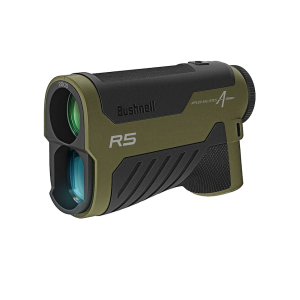
The Bushnell R5 2000 AB fits that role well. Its 2,000-yard class range is more than adequate for most hunting scenarios, and the AB designation indicates that it includes Applied Ballistics support.
That makes it particularly appealing to hunters who want to move beyond basic ranging and begin using a more complete shooting solution.
It is more rangefinder than most bowhunters need, but it can be a strong choice for rifle hunters who hunt a mixture of eastern and western terrain and want ballistic tools without paying flagship-model prices.
Best Overall Hunting Rangefinder: Vortex Razor HD 4000
A strong all-around rangefinder should be capable in short-range hunting situations while still offering enough power, optical quality, and target performance for serious western use.
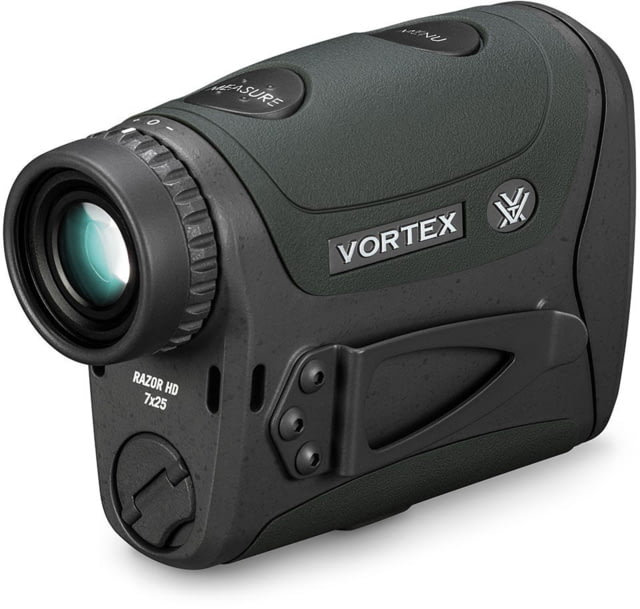
Vortex Razor HD 4000 Laser Rangefinder 7x25mm 4000 yds Green/Grey 4.4in 9.9oz
The Vortex Razor HD 4000 is our best overall choice because it combines long-range capability with premium optics and a hunting-oriented design.
Its extended range provides flexibility for measuring distant terrain, planning stalks, and ranging targets in open country. The higher-quality optics also matter when the rangefinder is being used near dawn or dusk, against shaded slopes, or on animals that blend into the landscape.
A whitetail hunter may not use its full range, but the unit can still serve effectively at close and moderate distances. A western hunter is more likely to benefit from its stronger performance on distant targets and broad terrain.
This is the option for someone who wants one premium rangefinder that can handle nearly any hunting trip without immediately moving into a specialized ballistic flagship.
Best Premium Long-Range Rangefinder: Leupold RX-5000
The most advanced rangefinders are intended for hunters and shooters who expect dependable performance at extended distances and want more information than a simple yardage reading.
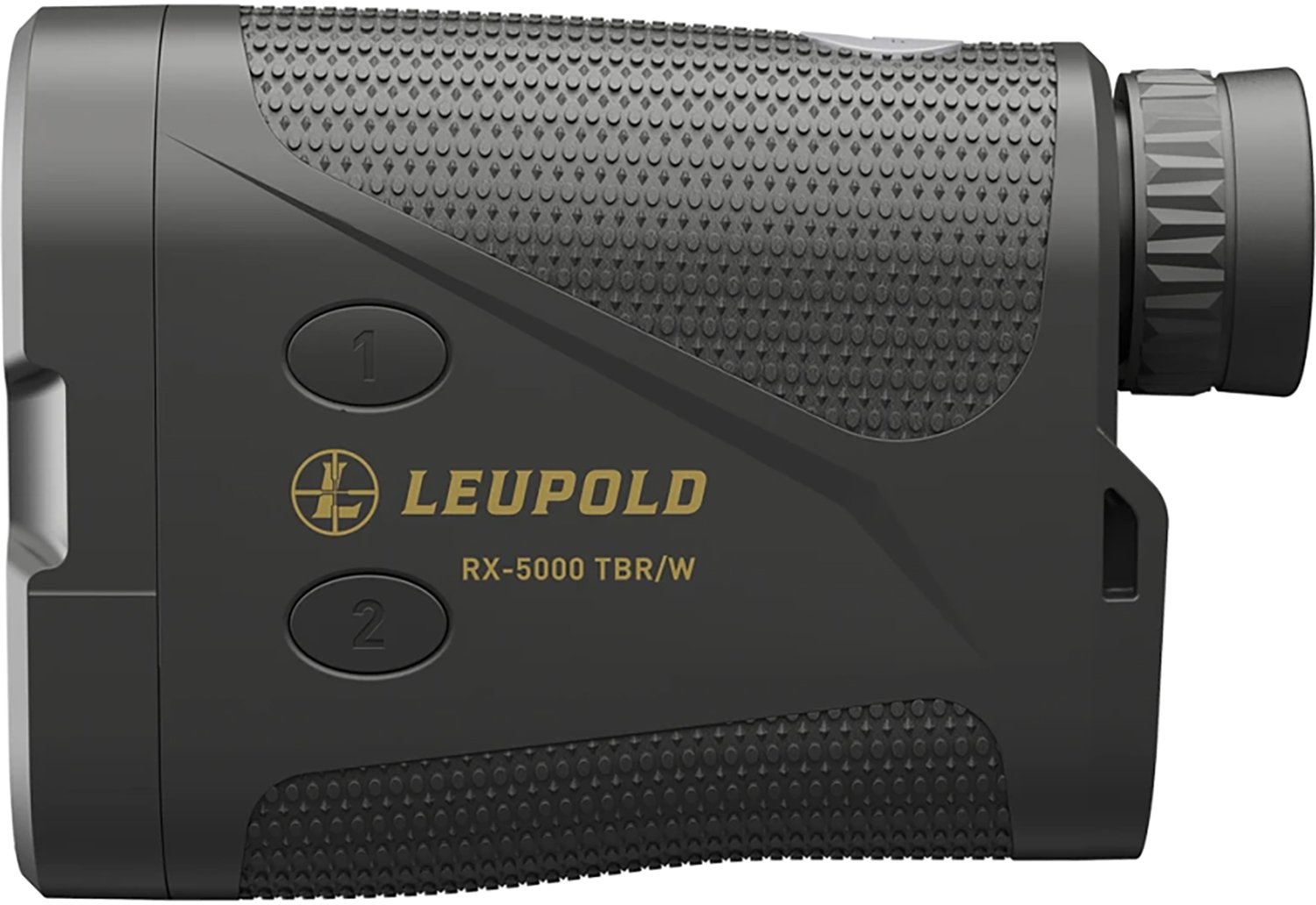
The Leupold RX-5000 is the premium long-range selection in this guide. Its extended ranging capability makes the most sense in open country where distant landmarks, slopes, animals, and shooting positions may all need to be measured.
This level of equipment is best suited to experienced rifle hunters who understand their ammunition, verify ballistic data, and are comfortable interpreting the information the unit provides.
It is not necessary for a typical tree-stand hunter or someone whose rifle opportunities rarely exceed 200 yards. Its value appears when the hunt itself demands longer ranging performance and the hunter has the skill to use it responsibly.
How Far Should You Be Willing to Shoot?
A rangefinder can tell you the distance. It cannot tell you whether you should take the shot.
Ethical range depends on much more than the number displayed on the screen. Hunters should consider:
- Verified accuracy from field positions
- Wind speed and direction
- Animal movement
- Available shooting support
- Visibility and target identification
- Time of flight
- The hunter's current confidence and physical condition
A hunter may be comfortable and consistently accurate at 400 or 500 yards after extensive practice with a stable rifle system. Another hunter may choose to remain inside 250 yards. Both decisions can be responsible when they reflect demonstrated ability rather than ego.
The rangefinder should support the hunter's ethical limit, not encourage the hunter to exceed it.
Our Hunting Rangefinder Recommendations for 2026
- Best Overall: Vortex Razor HD 4000
- Best Value: Bushnell R5 2000 AB
- Best Budget: TideWe 700/1000Y Rangefinder
- Best Premium Long-Range: Leupold RX-5000
Frequently Asked Questions
Do bowhunters need angle compensation?
Yes. Angle compensation is especially useful from tree stands and in steep terrain because the direct line-of-sight distance may be longer than the effective horizontal shooting distance.
Is a 1,000-yard rangefinder enough for deer hunting?
For most eastern deer hunters and nearly all bowhunters, a dependable 1,000-yard unit is more than sufficient. Hunters in open western terrain may benefit from a longer-range model for measuring distant animals and landmarks.
How far can a rangefinder range a deer?
That depends on the model, target size, target reflectivity, weather, stability, and surrounding vegetation. A rangefinder's maximum advertised range is often measured on a large reflective target and may be much greater than its dependable range on a deer.
Are expensive rangefinders more accurate?
Many basic and premium rangefinders are accurate at normal hunting distances. Premium models usually distinguish themselves through faster readings, longer real-world target range, better optics, improved displays, stronger ballistic features, and more dependable performance in difficult conditions.
Do I need a ballistic rangefinder for rifle hunting?
Not necessarily. Hunters who normally shoot inside 200 yards may only need dependable distance and angle compensation. Ballistic features become more useful for longer shots where bullet drop and environmental factors have a greater effect.
Can I use one rangefinder for both bowhunting and rifle hunting?
Yes. A model with reliable close-range readings, angle compensation, and enough maximum range for your rifle hunting can serve both purposes. The controls and display should remain practical at both short and long distances.
What is scan mode on a rangefinder?
Scan mode continuously updates the distance while the rangefinder moves across terrain or follows a target. It helps hunters evaluate changing distances, range multiple landmarks, and track moving animals.
Should I range an animal or nearby terrain?
Whenever possible, range the animal directly. If the animal is difficult to range, use a nearby rock, tree, or patch of terrain at approximately the same distance. Hunters can also range landmarks in advance before an animal appears.
Final Thoughts
The best hunting rangefinder is not the one with the largest number printed on its packaging. It is the model that provides dependable information within the distances and terrain where you actually hunt.
Bowhunters and eastern whitetail hunters should prioritize angle compensation, fast close-range readings, clear displays, and simple operation. The TideWe 700/1000Y model offers an affordable way to cover those basic needs.
Rifle hunters who want additional range and ballistic support should consider the Bushnell R5 2000 AB. Hunters seeking a premium all-around unit for both close hunting and western terrain will find more capability in the Vortex Razor HD 4000.
The Leupold RX-5000 is best reserved for experienced long-range hunters who can take advantage of its extended performance and advanced features.
A rangefinder provides the number. The hunter still has to understand the angle, know the equipment, evaluate the conditions, and decide whether the shot belongs within an ethical and practiced limit.