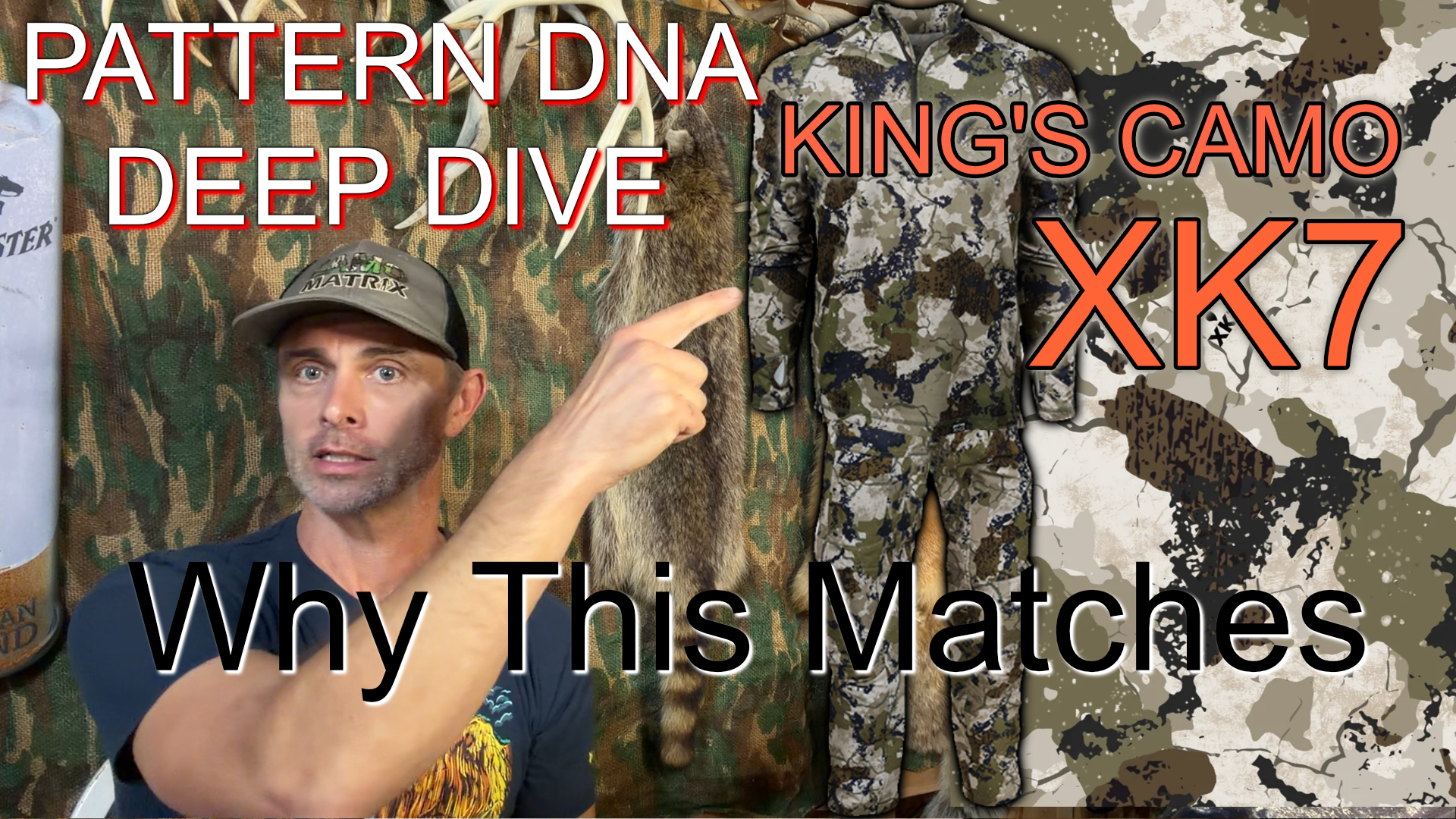
When I compared King’s Camo XK7 with a dense evergreen timber scene at mid range, it finished first among the eight patterns in my owned collection and third out of 222 eligible patterns overall. Its strongest alignment was in edge, texture, and tone.
That result gives us a useful case study: how do the measured characteristics of a camouflage pattern relate to the branches, foliage, trunks, and shadows in a hunting background? In this Camo Matrix deep dive, we look at XK7’s Pattern DNA, then connect those findings with the Terrain DNA comparison.
What Pattern DNA tells us about XK7
Pattern DNA describes the visual structure of the analyzed camouflage sample. Terrain DNA compares measured pattern traits with a selected terrain crop at a chosen viewing range. Together, they help explain both what a pattern looks like and how closely its characteristics align with a specific background.
XK7’s Pattern DNA descriptions use the frozen 247-pattern reference collection. The terrain test below ranks 222 eligible nonmilitary patterns. Those are different comparison groups serving different purposes.
Color and the balance of light and dark
The analyzer identifies brown and black as XK7’s primary detected color families. Those labels summarize the palette rather than naming every visible shade.
The sampled pattern has a substantial dark component, a similar amount of mid-tone material, and a smaller light component:
King’s Camo XK7 sample tonal distribution
| Tonal group | Share of analyzed sample |
|---|---|
| Dark | 49.8% |
| Mid | 42.0% |
| Light | 8.3% |
Percentages are rounded and may not total exactly 100%.
Despite that dark component, XK7 sits in the middle range for overall brightness relative to the reference collection. It also has high tonal separation. Average brightness describes the pattern’s overall lightness; tonal separation describes how distinctly its tonal groups differ. A middle-brightness pattern can still contain pronounced light-and-dark differences.
Large structure supported by smaller detail
XK7 is classified as large-scale dominant. Its measured scale contributions are:
King’s Camo XK7 measured scale contributions
| Scale | Contribution |
|---|---|
| Fine | 27.7% |
| Mid | 31.7% |
| Large | 40.6% |
These figures describe contributions at different visual scales, rather than percentages of physical pattern area. Large structure contributes the most, with substantial fine and mid-scale contributions as well.
As a pattern appears smaller with distance, fine details become less distinct and broader structure becomes more prominent. That is why the selected viewing range matters in a terrain comparison.
Variable texture and mixed edges
XK7’s texture activity changes across the sample. Some areas carry more detail, while others are less busy. Its texture uniformity is low relative to the reference collection, even though fine texture density and roughness are broadly typical.
Its edge structure is mixed, with a high share of qualifying edges classified as hard. This does not mean every boundary is sharp or that its average edge strength is unusually high. It describes the proportion of measured edges falling into that harder category.
Its overall measured shape structure is typical of the reference set. For this terrain example, the changing texture and mixture of boundaries provide more useful features to examine.
The timber test
The selected crop contains shaded evergreen foliage, dark trunks, pale branches crossing at different angles, and small openings of brighter light. I chose mid range, where some fine detail blends together while larger edges and structure remain distinct. Terrain DNA does not assign an exact yardage to that setting.
For this crop and range, XK7 ranked:
- First of eight compared owned patterns.
- Third of 222 eligible patterns overall.
The trait breakdown shows where its alignment was strongest:
King’s Camo XK7 measured scale contributions
| Trait | Alignment | Rank out of 222 |
|---|---|---|
| Edge | Strong | 15 |
| Texture | Strong | 19 |
| Tone | Strong | 29 |
| Scale | Good | 44 |
| Color | Good | 51 |
Tone includes brightness and contrast. Alignment labels are relative to eligible nonmilitary patterns for this terrain and range.
Interpreting the result
The distinct branch and trunk boundaries, varying concentrations of detail, and differences between illuminated areas and shade are the visible features I would point to when explaining the strong edge, texture, and tone alignment. That is my interpretation of the photograph alongside the measured results.
Color also earned Good alignment, despite the green foliage in the scene and XK7’s detected brown and black primary families. The background includes bark, pale branches, and shaded areas as well as foliage. Looking at that whole combination gives us more to consider than its most noticeable color.
This third-place finish applies to the selected crop and mid-range comparison. It measures visual similarity; it does not establish how often an animal would detect a hunter. Another crop, lighting condition, or range can produce a different result.
Where XK7 may fit
XK7’s profile suggests a useful starting point in backgrounds with broken tonal variation, broader structural features, and changing amounts of surface detail. This timber example shows strong measured alignment in several of those characteristics.
Flatter, lower-contrast backgrounds or scenes dominated only by tiny repetitive detail may be less natural matches according to its profile. Testing a photo of your own location is more useful than assuming one result applies to every woodland setting.
The garment matters too
The right camouflage may give you an extra edge when its visual traits align with your surroundings. The clothing carrying it also needs to suit the weather, terrain, and way you hunt.
Warmth, breathability, freedom of movement, and quiet fabric all affect the hunting experience. If you are cold, overheating, or uncomfortable, staying still becomes harder. Clothing that makes noise whenever you move can undermine the advantage of a suitable visual match.
For a stationary sit, consider the comfort and warmth needed during long periods of inactivity. For an active hunt, consider ventilation, mobility, and how your layers manage changing effort. Evaluate those garment features alongside the pattern.
Choose camouflage that fits your surroundings and clothing that helps you stay comfortable, move quietly, and hunt effectively.
Explore XK7 clothing from King’s Camo
If XK7 looks like a useful option for your terrain, explore the garments available directly from King’s Camo. Consider each item’s materials, fit, and features alongside the conditions and style of hunting you have in mind.
Affiliate disclosure: Camo Matrix may earn a commission if you purchase through the link below, at no additional cost to you. Affiliate relationships do not affect Pattern DNA measurements or Terrain DNA rankings.
Shop XK7 products at King’s Camo
Compare XK7 with your terrain
Explore King’s Camo XK7 in Camopedia for its Pattern DNA overview.
To try your own comparison, open Terrain DNA, upload a representative hunting photo, select the area you want measured, and choose a viewing range. Save the camouflage you own in My Camo to compare your existing choices with that terrain.
XK7’s result in this timber scene gives us a specific example to explain. Your own hunting background is the next place to look.
King's Camo XK7