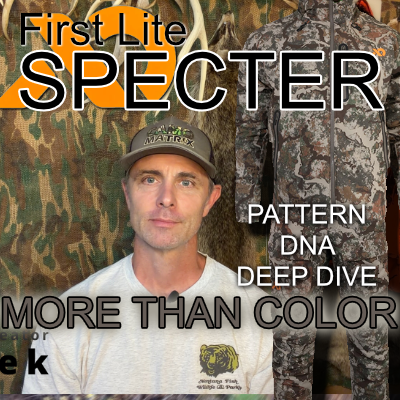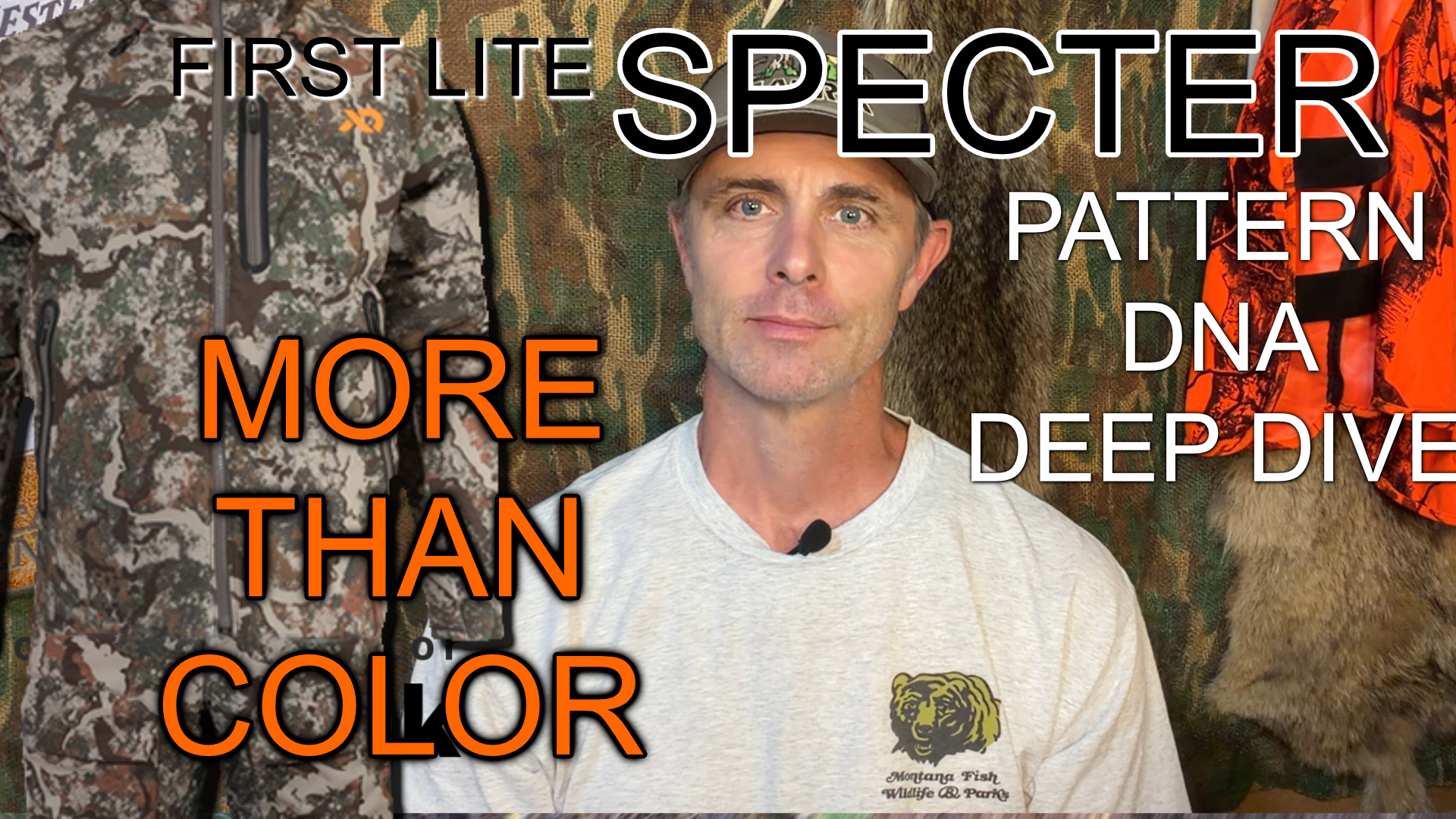
First Lite Specter Deep Dive: Why Color Isn't the Whole Story
First Lite calls Specter a whitetail hunting pattern. But what makes it different from the camouflage you already own?
I checked Specter against a photo of my fall season eastern whitetail woods using Terrain DNA at mid range. It ranked first among my seven saved patterns and eighth out of 222 eligible patterns overall. What caught my attention was that color wasn't its strongest match.
Scale, edge, and texture were the stronger alignments. That result is a useful way to introduce our revived Camo Matrix Deep Dives: look closely at the pattern's measured characteristics, then compare them with an actual hunting background.
Affiliate disclosure: Camo Matrix is a First Lite affiliate and may earn a commission from qualifying purchases through affiliate links, at no additional cost to you. Affiliate relationships do not affect our measurements or rankings.
What Specter was designed to do
After hunting elk in Montana in the early season, I'm back in North Carolina with whitetail hunting on my mind. Specter is the first pattern we're exploring in this new series.
First Lite describes Specter around treestand hunting, combining larger disruptive shapes with smaller elements for closer encounters. That is the maker's design intent. Pattern DNA lets us examine the visual characteristics of the sample itself.
Color and tone in the measured sample
Specter combines muted gray and brown with green and rusty accents. Our analysis identifies gray and brown as the leading color families in the sample we measured. Those leading families do not describe every visible color in the design.
The measured tonal distribution breaks down as follows:
First Lite Specter sample tonal distribution
| Tonal category | Share of sample |
|---|---|
| Dark | 40.1% |
| Midtone | 54.8% |
| Light | 5.2% |
Values are rounded independently and may not total exactly 100%.
In other words, most of the analyzed sample sits in the dark and middle tonal categories, with a smaller share in the light category. This describes the image sample, rather than a guarantee about every printed garment or lighting condition.
The current Specter Pattern DNA profile places overall brightness in the middle range of our reference collection and tonal separation within the typical range. Average brightness and light-and-dark separation answer different questions: two patterns can have similar average brightness while distributing their tones differently.
Scale adds another part of the picture
Specter is large-scale dominant in our analysis. Broader structure makes the strongest contribution, while fine and medium detail remain present.
Think about the background behind your hunting position. Broad trunks and shadow areas create a different visual structure from a dense wall of small twigs and leaves. Matching the general colors does not tell us whether the sizes of those features align.
That is why the terrain example matters. It gives us a specific background and range against which to evaluate the pattern.
My fall whitetail woods at mid range
The woodland photo I used contains tree trunks, crossing branches, layers of leaves, and patches of shadow. I selected mid range in Terrain DNA and checked it against the patterns saved in My Camo.
Specter ranked 1 of 7 compared owned patterns. Its overall database rank was 8 of 222 eligible nonmilitary patterns.
Specter alignment with this selected terrain at mid range
| Trait | Alignment | Rank of 222 |
|---|---|---|
| Scale | Strong | 6 |
| Edge | Strong | 12 |
| Texture | Strong | 15 |
| Tone | Good | 78 |
| Color | Moderate | 125 |
Ranks and labels are from this recorded analysis, relative to its 222 eligible nonmilitary patterns. Tone includes brightness and contrast. These are terrain-specific results, not a universal ranking of Specter.
The useful finding: Specter placed eighth overall even though color ranked 125th. Its stronger scale, edge, and texture alignment would have been missed by looking at color alone.
These results describe measurable visual alignment with the selected background at mid range. They do not establish how difficult a deer would find it to detect a hunter.
What I take from this example
The result gives me a reason to consider Specter for this particular background. Its larger structure and consistent texture are useful traits to consider alongside its muted grays and browns, with green and rusty accents.
Your spot may look different. Even within the same woods, the background behind one stand can differ from the background behind another. This analysis is a starting point for checking your own choices.
A clothing option in Specter
The First Lite team recommended highlighting the Navigator Hoody in Specter as a popular option. According to the brand's product description, it pairs a quiet, stretchy outer fabric with breathable, moisture-wicking fleece inside. It is designed to work as an outer layer in milder conditions or underneath additional insulation when temperatures drop.
This is a product spotlight based on the manufacturer's description, rather than a personal field test of the hoody.

Check Specter against your own terrain
- Open Terrain DNA and upload a photo of your hunting terrain.
- Select the background you want to analyze and choose the range.
- Evaluate Specter directly, or add your owned patterns to My Camo and compare your existing collection.
That is what I did here: checked which of my saved patterns had the strongest measured alignment with this terrain.
Pattern DNA helps us understand the camouflage. Terrain DNA helps us compare it with where we hunt.
Try your own hunting background, and let me know which pattern you would like us to take a closer look at next.